Let’s face it: very few restaurants in the world have dedicated gluten-free kitchens. If you are newly gluten free, the thought of eating out can be terrifying. If you’ve been gluten free for a while, the thought of easting out in a restaurant can be…enough to make you want to stay home and cook a four-course meal.
It just seems easier.
The good news is the number of restaurants offering choices to gluten-free diners is increasing rapidly. But there is also bad news, so let’s start with that.
Very few of those restaurants can guarantee a wholly safe environment. For example, my local pizza place offers a gluten-free crust, an option that is so popular, it’s prominently featured in the printed menu. I’ve been very lucky when it comes to avoiding cross-contamination, but I am *always* aware this is a possibility.
I mean, it’s a pizza joint. There is flour everywhere in that kitchen. All the precautions in the world cannot eliminate that fact, and I think long and hard before I order pizza. I know I’m taking a risk, and, sigh, end up ordering a salad more often than not. Being glutened is never fun. This is true of just about every restaurant you, me, and all of our gluten-free compatriots enter.
Then there are restaurants who know they must offer *something* for the gluten-free diner, but don’t have the underlying knowledge to do it right. Or maybe they aren’t willing to truly commit to what it means to offer safe gluten-free options to their customers…
Yeah, I’m looking at you, quinoa. Don’t get me wrong, I enjoy quinoa very much, and am glad my gluten-free life lead me to discovering it. But quinoa has become the signal that a restaurant item is gluten free. I find that limiting, boring, and, yes, a bit condescending. Smart chefs know that most of the foods on their menu are naturally gluten free; suggesting there is only one food that is safe annoys me.
(Puts away soapbox for the moment, and concentrates on the good news.)
It *is* possible to eat safely in restaurants, but it does take some work. Here are my key tips:
1. Understand The Menu. As noted in my pizza joint example above, certain restaurants are going to be more challenging that others. Certain cuisines — South American, Mexican, Indian, and others — are more inherently gluten free than others. This includes Chinese restaurants (soy sauce galore!), though if you’re cautious, you can eat, well, okay in most establishments. You may be stuck with steamed veggies and plain rice, but that’s not the worst thing ever.
2. Understand The Ingredients. This is absolutely essential. For example, soy sauce, which is wheat-based, shows up in all sorts of foods (especially salad dressings and sauces). Breaded items, fried items, even fish can have wheat flour (fish is often dusted with flour to help with browning). Learn the lingo to help identify hidden sources of gluten.
3. Be Your Own Advocate. I ask a lot of questions. A lot. And one key clue about my potential safety comes during my first encounter with waitstaff. If they don’t know their menu, don’t understand what gluten free means, or, ahem, say “is rice okay?”, then I assume they are not well-trained. I immediately ask to speak with a manager or the chef. This seems harsh, but it’s my life.
4. Don’t Be *That* Person. You know the person I’m talking about. Heck, you’ve been out with that person. The person who, during the busiest hours at a restaurant decides to dissect each and every menu item because they’re “gluten free”…and then they order a beer with their meal. If it’s a new-to-me place, I spend time in advance studying the menu (most places have their menus online), and, if I have time, I even call ahead to ask questions. I find I get much better service if I’m prepared and focused.
5. Be Clear. Explain that you are gluten free for health reasons, serious health reasons. Don’t equivocate. No, it’s not okay if onion rings are fried in the same oil as your fries. No, it’s not okay to “just take it off” when bread is accidentally placed on your plate. Be very clear, and read the next tip!
6. Accept What You Can’t Change. Celiac is *not* an allergy; we know this. But waitstaff are, generally, trained in the dangers of serving the wrong ingredients to people with serious allergies. I used to complain to my husband, but now I accept that “allergy” is critical shorthand in the restaurant world.
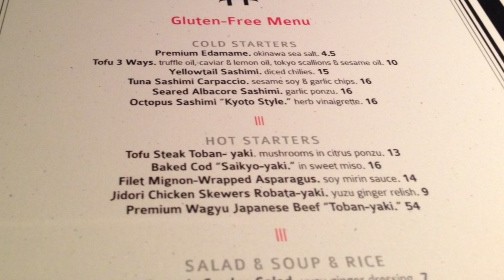
7. Ask For a GF Menu. Many restaurants, particularly chain restaurants, have a) a separate menu, b) allergen information on their menu items, or c) clear indicators that an item is gluten free on their menu. of course, when you’re ordering a GF meal, it is still your responsibility to make it clear you are ordering gluten free. Do not assume the server can read your mind.
8. Plan In Advance. When making reservations, let the restaurant know there is a gluten-free diner in the party. When trying a new restaurant, do your homework (in off-peak hours, if you’re calling). Figure out your menu modifications in advance, if necessary. The way to safety is taking care. The way to take care is to be prepared.